
The Nikon D50, a popular DSLR, boasts a comprehensive manual available in PDF format for detailed guidance.
Nikon’s Manual Viewer 2 app offers convenient access, while online resources and communities provide further support for mastering this camera.
What is the Nikon D50?
The Nikon D50 is a 6.2-megapixel digital single-lens reflex (SLR) camera, released in 2005, designed for photography enthusiasts seeking a step up from point-and-shoot cameras. It’s known for its user-friendly interface and excellent image quality.
A detailed instruction manual, readily available as a PDF download, guides users through every aspect of the camera’s operation. Nikon provides resources like the Nikon Manual Viewer 2 app for mobile access to documentation.
The camera’s manual covers everything from basic settings to advanced techniques, ensuring users can fully utilize its capabilities. It’s a robust and reliable camera, well-supported by extensive documentation and a thriving online community.
Key Features and Specifications
The Nikon D50 boasts a 6.2-megapixel DX format CCD image sensor and utilizes Nikon’s exclusive image processing engine. Key specs include a 9-point autofocus system and a continuous shooting rate of up to 3 frames per second.
The comprehensive instruction manual details these features, alongside explanations of its 2.0-inch LCD screen and compatibility with Nikon DX-format lenses. Accessing the PDF version of the manual provides in-depth information on utilizing these specifications.
Furthermore, the Nikon Manual Viewer 2 app offers a digital version for convenient reference. Understanding these features, as outlined in the guide, unlocks the camera’s full potential.
Getting Started with Your Nikon D50
The Nikon D50 manual guides initial setup, battery insertion, and memory card installation. Download the PDF or use Nikon’s app for easy access!
Unboxing and Initial Setup
Upon unboxing your Nikon D50, carefully inspect all included components. The manual, available as a PDF download or through the Nikon Manual Viewer 2 app, is your primary resource. Begin by identifying the camera body, lens, battery, charger, and various cables.
Before powering on, familiarize yourself with the camera’s exterior. The manual details each button and dial’s function. Initial setup involves selecting your language, date, and time; Ensure the battery is fully charged using the provided charger before proceeding. The PDF version of the manual offers detailed diagrams to aid in this process, while the app provides a convenient digital reference.
Inserting the Battery and Memory Card
Refer to your Nikon D50 manual – available as a PDF or via the Nikon Manual Viewer 2 app – for precise instructions. Locate the battery compartment, typically on the bottom of the camera. Insert the battery, ensuring correct polarity, until it clicks into place.
Next, find the memory card slot, usually alongside the battery compartment. The manual specifies compatible card types. Gently insert the memory card until it locks; Proper insertion is crucial for data storage. The PDF manual provides visual aids. Always power off the camera before inserting or removing either the battery or memory card to prevent data corruption.
Understanding the Camera Controls
Consult the Nikon D50 manual – accessible as a PDF download or through Nikon’s Manual Viewer 2 app – to familiarize yourself with the camera’s layout. Key controls include the mode dial for selecting shooting modes, the shutter button for capturing images, and the control dials for adjusting settings.
The manual details the function of each button and dial. Learn to navigate the menu system for customizing settings. Understanding these controls, as outlined in the guide, is essential for taking full advantage of the D50’s capabilities. Diagrams within the PDF version aid in identifying each component and its purpose.
Basic Photography with the Nikon D50
The Nikon D50 manual details shooting modes like Auto and Scene, alongside autofocus and manual focus options.
Mastering exposure – aperture, shutter speed, and ISO – is key.
Shooting Modes: Auto and Scene Modes
The Nikon D50’s instruction manual clearly explains its versatile shooting modes. Auto mode simplifies photography, letting the camera handle all settings for quick, effortless shots. For more control, explore Scene modes – Portrait, Landscape, Close-up, and Sports – each optimized for specific subjects and conditions.
The manual guides users through selecting the appropriate Scene mode for desired results. Portrait mode blurs backgrounds, emphasizing the subject, while Landscape prioritizes sharpness and detail across the entire frame. Close-up excels at macro photography, and Sports freezes action. Understanding these modes, as detailed in the PDF guide, empowers photographers to capture stunning images without complex manual adjustments. The Nikon Guide to Digital Photography further enhances understanding.
Focusing Modes: Autofocus and Manual Focus
The Nikon D50’s instruction manual details two primary focusing methods: Autofocus (AF) and Manual Focus (MF). AF automatically adjusts lens focus for sharp images, offering various AF-area modes for different scenarios. The manual explains Single-servo AF for stationary subjects and Continuous-servo AF for tracking moving objects.
Manual Focus allows precise control, ideal for challenging situations where AF struggles. The PDF guide illustrates how to switch between AF and MF using the focus mode selector. Mastering both modes, as outlined in the Nikon documentation, is crucial for achieving consistently sharp results. The Nikon Guide to Digital Photography provides additional insights into optimizing focus for various photographic styles.
Understanding Exposure: Aperture, Shutter Speed, and ISO
The Nikon D50’s manual thoroughly explains the exposure triangle: aperture, shutter speed, and ISO. Aperture controls lens opening, affecting depth of field; the manual details f-stop values. Shutter speed determines exposure duration, impacting motion blur – guidance is provided in the PDF. ISO adjusts camera sensitivity to light, influencing image noise.
The Nikon documentation emphasizes balancing these settings for optimal exposure. Understanding their interplay, as described in the manual, is vital for creative control. The Nikon Guide to Digital Photography further clarifies these concepts. Correct exposure ensures well-lit, detailed images, and the manual offers practical examples for various shooting conditions.

Advanced Photography Techniques
The Nikon D50 manual details lens compatibility, flash utilization, and white balance adjustments for enhanced creativity. Explore these features for superior image quality!
Working with Lenses and Accessories
The Nikon D50 manual provides crucial information regarding compatible Nikon lenses, detailing their specific functionalities and optimal usage with the camera body. It explains how to properly attach and detach lenses, ensuring a secure connection and preventing damage.
Furthermore, the manual guides users on utilizing various accessories, such as filters, to enhance image quality and achieve creative effects. It covers the proper mounting and operation of external flashes, expanding lighting options beyond the built-in flash.
Understanding lens characteristics, like focal length and aperture, as outlined in the manual, is key to mastering photographic techniques. The manual also touches upon the benefits of using Nikon Capture 4 software for advanced image editing and management.
Utilizing the Built-in Flash
The Nikon D50 manual details the operation of its integrated flash, explaining its various modes – Auto, Fill, Red-eye Reduction, and Manual. It clarifies when to use each mode for optimal results in different lighting scenarios. The manual emphasizes understanding flash synchronization with shutter speed to avoid dark images or partially illuminated subjects.
Users learn how to adjust flash compensation to fine-tune the flash output, preventing over or underexposure. The manual also covers utilizing the flash as a secondary light source, combined with ambient lighting.
It provides guidance on minimizing red-eye effects and maximizing flash range. Referencing the manual ensures photographers effectively harness the built-in flash for improved image quality and creative control.
Exploring White Balance Settings
The Nikon D50 manual thoroughly explains white balance, crucial for accurate color rendition. It details preset modes like Daylight, Cloudy, Fluorescent, and Tungsten, guiding users to select the appropriate setting for their lighting conditions. The manual clarifies how custom white balance allows for precise color correction by metering a white object.
Understanding the Kelvin temperature scale is also covered, enabling manual adjustment for nuanced color control. The manual emphasizes the impact of incorrect white balance on image appearance, highlighting the importance of accurate settings.
It provides tips for correcting white balance in post-processing if needed, but stresses achieving it in-camera for optimal results. Referencing the manual unlocks the potential for vibrant and true-to-life colors.
Navigating the Nikon D50 Menu System
The Nikon D50 manual details its menu, allowing customization of settings. Users can explore setup options, review images, and delete files efficiently, as outlined in the guide.
Customizing Camera Settings
The Nikon D50 instruction manual provides extensive details on personalizing your camera experience. Dive into the menu system to tailor settings to your shooting style and preferences. You can adjust image quality, file size, and white balance for optimal results.
Explore options for autofocus modes, metering methods, and ISO sensitivity to fine-tune performance in various conditions. The manual guides you through customizing button assignments and display settings for enhanced usability.
Furthermore, you can configure the camera’s setup menu to manage language, date/time, and other system preferences. Utilizing the Nikon Manual Viewer 2 app can aid in navigating these settings on the go, ensuring you unlock the full potential of your D50.
Understanding the Setup Menu
The Nikon D50 instruction manual dedicates significant attention to the Setup Menu, your central hub for camera configuration. This menu allows adjustments to fundamental settings like language selection, date and time formatting, and display brightness.
You’ll find options to manage file naming conventions, customize button functions, and reset the camera to factory defaults. The manual details how to format memory cards and configure USB connectivity for image transfer.
Understanding these settings is crucial for optimal camera operation. The Nikon Manual Viewer 2 app provides a digital reference, while online resources offer further clarification. Mastering the Setup Menu ensures a personalized and efficient shooting experience with your D50.
Reviewing and Deleting Images
The Nikon D50 instruction manual thoroughly explains image review and deletion processes. After capturing photos, utilize the playback mode to view images individually or in multi-image displays. Zoom functionality allows detailed inspection of sharpness and composition.
Deleting unwanted images is straightforward; select the image(s) and press the delete button. The manual cautions against accidental deletion and outlines the confirmation prompts. You can delete all images at once, or selectively remove specific files.
Referencing the Nikon Manual Viewer 2 app or online guides can clarify any uncertainties. Proper image management, as detailed in the manual, ensures efficient storage and organization of your photographic work.

Troubleshooting Common Issues
The Nikon D50 instruction manual addresses issues like power failures, focusing problems, and error messages, offering solutions for smooth operation and continued use.
Camera Not Turning On
If your Nikon D50 fails to power on, the instruction manual suggests several checks. First, ensure the battery is correctly inserted and fully charged. Try a different, known-good battery if possible.
Verify the battery contacts within the camera aren’t dirty or damaged; gently clean them with a soft, dry cloth. Confirm the power switch is set to the ‘ON’ position.
Also, check the battery compartment for any obstructions. If the issue persists, consult the manual’s troubleshooting section for potential error codes or further diagnostic steps. A depleted or faulty battery is the most common cause, but other internal issues may require professional repair.
Focusing Problems
Experiencing focusing issues with your Nikon D50? The instruction manual details autofocus (AF) and manual focus (MF) modes. Ensure you’ve selected the appropriate AF mode for your subject – single-servo (AF-S) for stationary objects, and continuous-servo (AF-C) for moving subjects.
Verify the focus point is positioned over your intended subject. Try switching between autofocus-area modes (auto-area, closest-subject, center-point, etc.). If using manual focus, carefully rotate the focusing ring on the lens until the image appears sharp in the viewfinder.
Low light or low contrast can hinder autofocus performance. Refer to the manual for guidance on using the AF-assist illuminator if available.
Error Messages and Solutions
Encountering error messages on your Nikon D50? The instruction manual provides a comprehensive list and troubleshooting steps. Common errors include “Battery Low,” requiring a charge or replacement. “Card Full” indicates the memory card needs replacing or images deleted.
“Lens Not Attached” confirms a connection issue; reattach the lens securely. Other messages might relate to internal camera errors. The manual suggests turning the camera off and on, or removing and reinserting the battery and memory card.
If errors persist, consult the manual’s dedicated troubleshooting section or Nikon’s support website for more advanced solutions.

Resources and Further Learning
Explore Nikon’s official manual (PDF download), the Nikon Manual Viewer 2 app, and vibrant online forums for enhanced learning and support.
Downloading the Nikon D50 Manual (PDF)
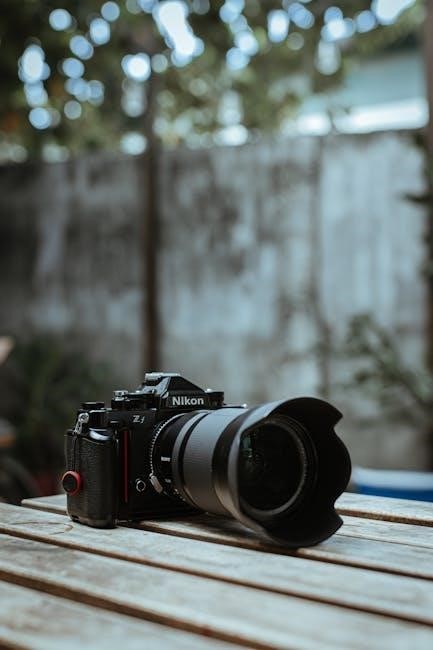
Accessing the Nikon D50’s complete instruction manual in PDF format is readily available online. Several websites host the document, offering a convenient way to study the camera’s features and functions at your own pace. ManualLib, for instance, provides a downloadable version, ensuring you have a reliable reference guide.
This PDF version allows for detailed exploration of every aspect of the D50, from basic operations to advanced settings. Diagrams and images, potentially more visible in the original document, enhance understanding. Utilizing free software like Adobe Reader ensures easy viewing and navigation of the PDF file. Having this manual readily accessible empowers you to fully utilize your Nikon D50’s capabilities.
Nikon Manual Viewer 2 App
Nikon’s Manual Viewer 2 app provides a modern and convenient way to access your D50’s instruction manual directly on your smartphone or tablet. Available for both iOS (iPhone, iPad, iPod touch) and Android devices, this application eliminates the need to carry a physical copy or search for the PDF online.
The app offers a user-friendly interface for browsing the manual’s contents, making it easy to find specific information quickly. While the app itself is free, viewing downloaded PDF manuals requires a PDF reader like Adobe Reader, also freely available. This combination provides a portable and accessible resource for understanding and mastering your Nikon D50’s features.
Online Forums and Communities
Beyond the official Nikon D50 manual, a wealth of knowledge resides within online forums and communities dedicated to Nikon photography. These platforms offer a collaborative environment where users share tips, troubleshooting advice, and in-depth discussions about the camera’s features.
Engaging with these communities can be invaluable for resolving specific issues, learning advanced techniques, and discovering hidden functionalities. Experienced D50 users often contribute helpful insights and alternative perspectives not found in the standard manual. Searching online will reveal numerous active forums where you can ask questions, participate in discussions, and expand your understanding of the Nikon D50.

Maintaining Your Nikon D50
Regular cleaning, proper battery care, and safe storage are crucial for longevity, as detailed in the Nikon D50 manual.
Cleaning the Sensor
Maintaining a clean sensor is vital for optimal image quality with your Nikon D50. Dust accumulation can lead to unwanted spots in your photographs. The official Nikon D50 instruction manual provides detailed guidance on this process, emphasizing caution to avoid damage.
Generally, it’s recommended to use a blower to remove loose particles first. If this isn’t sufficient, a sensor cleaning kit – available from Nikon or reputable third-party suppliers – should be employed. Always follow the kit’s instructions meticulously. Improper cleaning can scratch the sensor, requiring costly repairs.
The manual stresses the importance of a dust-free environment during cleaning. Consider performing this task in a clean room or a bathroom after a hot shower to minimize airborne particles. Regular sensor cleaning, as needed, will ensure your Nikon D50 continues to deliver sharp, clear images.
Battery Care and Storage
Proper battery care significantly extends the life of your Nikon D50’s power source. The Nikon D50 instruction manual advises fully charging the battery before its first use. Avoid frequent, complete discharges, as this can reduce its capacity over time. Partial charges are preferable.
When storing the battery for extended periods, discharge it to approximately 50% and store it in a cool, dry place. Avoid extreme temperatures, both hot and cold, as these can damage the battery. Never leave a fully charged or fully discharged battery unattended for prolonged durations.
The manual also recommends using only Nikon-approved chargers to prevent damage and ensure optimal charging performance. Regularly check the battery contacts for corrosion and clean them gently if necessary. Following these guidelines will maximize your battery’s lifespan and reliability.